britney waterriver + penelope cloverbear
Dress Code
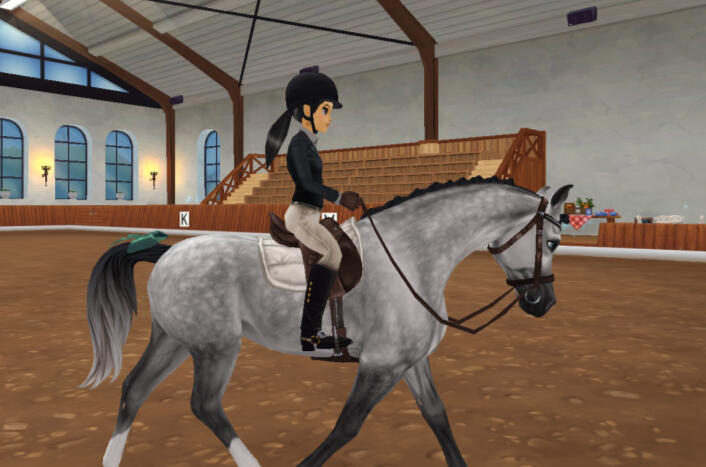
Dress Code for EquinePlain Black or Brown English Bridle with Cavasson Noseband
No Flash or Drop Noseband
Plain Brown or Black English Saddle
Small White, Brown or Cream Saddle Pad
No Leg Protection
(Leg protection permitted in Working Hunter however must be removed for second ridden show)
Indicator Tail Bows
Red - Kicking Horse
Yellow - Stallion
Green - Green Horse
White - For Sale
Blue - Aggressive Gelding
Pink - Mare in Season
Mane in Button Braids
(Hogged/Roached Style Permitted)Dress Code for RiderBlack, Brown, Grey, Navy, Green, Burgundy or Tweed Show Coat
(White Show Shirt Permitted for hot days)
Tan, Beige, Canary or White Riding Pants
Black Tall Boots for Over 16s, Black Paddock Boots for Under 16s.
Full Length Black or Brown Gloves
Black Helmet or Skull Cap with Black/Navy silk
Hair Tucked into Helmet
Minimal Accessories, Glasses Permitted
britney waterriver + penelope cloverbear
Breed Guide and Scoring
All generation 3 breeds are permitted at our shows, however some divisions are restricted to horse breeds only or pony breeds only. Below is our breed classification guide based on in-game models. We also have a few other types of restrictions detailed below.HORSE BREEDS
Akhal-Teke
American Paint Horse
American Quarter Horse
Andalusian
Arabian
Belgian Warmblood
Clydesdale
Curly Horse
English Thoroughbred
Finnhorse
Irish Cob
Jorvik Friesian
Jorvik Warmblood
Jorvik Wild Horse
Knabstrupper
Lusitano
Marwari
North Swedish Horse
Paso Fino
Percheron
Shire
Tennessee Walking Horse
Trakehner
Overgrown Connemara
MorganPONY BREEDS
Chincoteague Pony
Connemara
Fjord Horse
Gotland Pony
Haflinger
Icelandic Horse
Jorvik Starter Pony
Welsh Pony
Appaloosa
MorganBreed Restrictions
All of the following restrictions must be followed. Riders who disregard any of the following restrictions will receive score deductions or faults.No generation 1, 1.5, or 2 breeds may be shown.Magical breeds must be in their non-magic form during competitions. Unrealistic coat colors and markings are not permitted.The generation 3 Jorvik Starter Pony is banned from all Jumper divisions due to the jumping bug. This bug provides an unfair speed advantage.The generation 3 Icelandic Horse is banned from all Hunter and Equitation divisions due to their lack of extended canter.The following scores are used in Hunter divisions only. Breed suitability is not judged in Equitation or Jumper divisions. Scores are rated out of 10 total possible points based on movement, conformation, and jumping style. Scores are subject to change based on the current available breeds.Akhal-Teke 8
American Paint Horse 10
American Quarter Horse 8
Andalusian 8
Appaloosa 10
Arabian 10
Belgian Warmblood 10
Chincoteague Pony 8
Clydesdale 8
Connemara 10
Curly Horse 10
English Thoroughbred 10
Finnhorse 10
Fjord Horse 8
Gotland Pony 6
Halfinger 10
Irish Cob 6
Jorvik Friesian 10
Jorvik Starter Pony 8
Jorvik Warmblood 10
Jorvik Wild Horse 6
Knabstrupper 6
Lusitano 10
Marwari 6
Morgan 10
North Swedish Horse 6
Paso Fino 8
Percheron 6
Shire 8
Tennessee Walking Horse 8
Trakehner 10
Welsh Pony 10
britney waterriver + penelope cloverbear
Equitation + Ridden Classes
A Ridden Round will follow after all Working Hunter Riders have ridden their course
The Working Hunter Ridden Round will be judged like every other Ridden Round. Breed suitability, dress code, horse mood will be judged in the Ridden Round as only the course is judged in Working Hunter.All points from Working Hunter will be put to one side and riders will have a clean slate for their ridden round.
At the end, points from Working Hunter and the Ridden Round will be combined to make an overall score. The rider with the highest score will win.GO ROUND
All Riders from a Class will enter the arena and walk clockwise around the ring in a fashionable manner until the Judge enters the ring. Riders will listen to the judge's instructions before lining up along the long side of an arena and waiting their turn to perform a show for the judge.Enter the ring on the right rein at a good walk with a presence, judges will tend to look along just one side of the ring so as not to miss anyone. After walking around, you will all be asked to trot, then canter, then change the Rein, followed by a canter on the left rein before lining up.Gait Terminology
Down 1 - Reverse
Up 0 - Halt
Up 1 - Walk
Up 2 - Trot
Up 3 - Canter
Up 4 - Extended Canter
Up 5 - Gallop
Up 6 - Full GallopDress Code and Breed Suitability are scored out of 10 points each.
(See Breed Suitability in Previous Slide)Breed Suitability is scored in all divisions and each dress code error will deduct 2 points out of the total 100 possible points in a ridden or equitation class.Horse mood is scored out of 5 points
(Green Mood- 5/5 points, Yellow Mood - 3/5 points, Red Mood - 1/5 points)25/100 points goes on dress code, horse mood, horse level and breed suitability
Equitation and Ridden Scoring CriteriaIn all Under Saddle classes, scoring is done in the form of errors with the riders with the lowest scores placing last.
Every rider will begin on 0 points and must earn their points through avoiding the criteria below. The rider with the most points wins.Below is a list of possible errors that may be assigned. Riders who bring an equine that goes against our restrictions will be penalised, such as riding a banned breed or riding a pony in a horse-only division.- 10 Points - Cutting off another rider
- 10 Points - Facing the wrong direction in line up
- 10 Points - Riding through another rider
- 10 Points - Incorrect gait demonstrated
- 10 Points - Incorrect equine- 5 Points - Clumping together with other riders
- 5 Points - Changing direction to line up
- 5 Points - Riding too close when passing another rider
- 5 Points - Not riding left to left- 3 Points - Small circling or curling
- 3 Points - Excessively riding the quarter line
- 3 Points - Too close to other riders in line up
- 3 Points - Late transition- 2 Points - For each dress code error
- 2 Points - Poorly ridden corner, not smooth
- 2 Points - Excessive horse head pulling
- 2 Points - Taking too long to line up- 1 Point - Talking or gesturing during the class
- 1 Point - Riding too close to the rail
- 1 Point - Riding through bushes or decorationsOne point will be deducted for each breed suitability score under 10. For example, a horse with a breed suitability of 6 will only receive 6 points rather than 10 points.The difference between Equitation and Ridden Classes
(Every equitation and ridden classes will use a go-roundEQUITATION
Equitation refers to a rider's position while mounted and their ability to ride correctly and with effective aids. The rider, rather than the horse is evaluated. Judging criteria covers the rider's performance and control of the horse, use of the arena and proper attire. The performance of the horse is not judged but a poorly performing horse is considered to reflect the ability of the rider. Riders are expected to come up with their own show that consists of walk, trot, canter and a gallop. Horse 'tricks' such as rein backs, special moves and more are judged and encouraged.Each trick will be judged out of 10.No limit for points, rider with the most points wins.Breed suitability and mood of the horse are not judged in equitation classes. Only yourself as a rider is judged and your dress codeRIDDEN CLASSAll factors will be judged such as breed suitability, dress code and equine mood.
All shows are to be set by a judge and will be shown prior to the show.Each show is judged out of 100 points. - First Ridden
The First Ridden/beginner rider class is for children who are off the lead rein but don’t want to canter in a group, children will be around 12 and under.
There will be no cantering in this show.- Ridden Show
This is for all ages and horses but sometimes one-breed only shows and pony/horse shows will be held. Everything is judged and 'tricks' are not permitted.Breed suitability, mood and level of the horse are judged in ridden classes along with dress code of the rider.ANY AND ALL SHOWS ARE NOT TO EXCEED 3 MINUTES LONG
britney waterriver + penelope cloverbear
Working Hunter and Showjumping
WORKING HUNTERAll Working Hunter Rounds should be ridden at an extended canter in the correct order of jumps displayed on the course diagrams.Working Hunter Rounds are judged mainly on straightness and centerdness to jumps and overall smoothness.All courses, with the exception of lead rein courses should be ridden with a preference for long approaches and wide turms.Courtesy circles should be done if the first or last jump are close to the in or out gate.Working Hunter scoring is broken down by the following criteria
20% Based on breed suitability, dress code and equine mood.
80% Based on the execution of the jumps, turns, strides and courtesy circles.In each course, one fence will add 20 points to the finishing score. For example, if there are 10 fences, there are 200 points to achieve.All riders will begin their round on the starting number of points and any faults will result in points deducted.Going below a canter or getting hard stopped will result in 20 points deducted
Refusals will result in 50 points deducted, one refusal is allowed per round, riders will be excused after the second refusal.
Disobedience will result in 10 points removed.
A crooked, off centred jump will result in 5-10 points deducted depending on the state of the jump.
An off stride to a fence will result in 5-10 points deducted depending on the state of the stride.
Incorrect gait will deduct 10 points
Incorrect equine will deduct 10 points
Off course- disqualifiedEnding the course with 0 points will result in elimination.Those who finish their round without being excused will follow on to the equitation round
The rider who finishes with the most points will be the winner.SHOWJUMPING JUDGING
Judging CriteriaKnocking a Jump | 4 Faults including the front pole of an oxer or parallel
Refusing a Jump | 4 Faults, please note 3 refusals are permitted and after the 4th the rider will be excused (Running into the base of the jump, being hard stopped, missing the jump count as a refusal)
Leaving the Ring | Elimination
Going off of Course | Elimination
Falling off | Elimination- Phase 1
Untimed round, riders aim to jump a clear round in order to pass through to phase 2.
Gathering faults excludes the rider from phase 2. Ridden in any gait.- Phase 2
Otherwise known as a 'jump off,' all riders with a clear round from Phase 1 will join Phase 2 which is a timed round with a selection of a few jumps from the course.
Riders are encouraged to get around the course as fast as possible without any faults, this can include tight turns and galloping. It is advised to ride this phase in an extended canter and gallop.Riders are expected to be mindful of their horse's capability, ESAJ will not take responsibility to any injuries to rider or equine.